Breaking News

Friday, 26 May 2017

Cutting Machines - Coal Ploughes

Plough operating on a longwall face Coal Ploughs have had little application in Australia, and their main use has been in Europe, particularly in Germany where they were first developed. Essentially a plough is a large mass of steel, usually of a more or less triangular shape when viewed from the coal face or goaf sides, fitted with large "picks" (more like small agricultural plough blade tips) angled from the steel body towards the coal face. The plough height is the working height in the seam being mined (possibly a bit lower if the coal tops can be guaranteed to fall once the coal below is cut. These "picks" act in a fashion similar to chisels and break a narrow web of coal off the face (of the order of 300-400mm thick). In most cases there are no moving parts on a coal plough.
The plough itself is mounted on the front of the AFC and is pushed into the face by push cylinders mounted in the supports. The plough has an endless chain haulage attached to the rear, and is driven through sprockets on electric drive(s) at the face end(s).
The main advantages of ploughs compared to shearers are:
  • Cheap
  • Simple (no moving parts on the cutting machine itself)
  • Relatively low dust make
  • Able to keep exposed roof area very small (but a large number of chock movements would be required to maintain this)
Though only a small web is taken, in the right conditions production rates can be comparable to a shearer as the plough is operated at a relatively fast speed along the face.
Some disadvantages are:
  • Cutting height is fixed
  • Ability to cut stone is limited
  • With increasing cutting height, machine stability becomes more problematic
  • Grading can only be done using the AFC angle
  • There are safety implications with an exposed chain haulage.

Cutting Processes

It has been stated that a longwall advances by cutting slices off the block. This is relatively simple for hand worked faces and with a coal plough, but with mechanized longwalls using shearers the means of doing this is not as straightforward as it would at first appear because of the complexity of the equipment. To start with, the cutting machine has to cut into the face after each slice is taken to line itself up to cut the next web. It is incapable of cutting at right angles to the face, so has to be eased in at an angle. This is achieved by "snaking" the AFC on which the shearer travels, so that the cutter drum can cut a wedge shaped section of coal until the full depth of the web is attained.
It is possible to cut a full web in one pass and to do this in either direction, a process known as "Bi-directional or Bi-di cutting". An alternative is to cut in one direction only, known as "Uni-directional or Uni-di cutting", often actually cutting only part of the web height in one direction and the remainder in the reverse direction. There are other more complicated processes involving only taking half the web width in one pass and the remainder on the return.
At first glance Bi-di cutting would appear to be the quickest way to advance and frequently this is the case. However there are advantages with the other processes, relating to simplicity of operation, "steering" the face equipment, effect on the coal haulage system, power requirements on the shearer, location of operators in relation to dust sources, etc which can result in better productivity overall. The best system will often be different for different mines, particularly in different seam thicknesses and possibly even with different personnel.
If the full web is cut in one pass, more power for cutting is required and the shearer will move slower than is possible if only part of the seam is cut. This, and the simpler overall process, may allow Uni-di or other processes to attain similar production levels to Bi-di.
If a shearer cuts coal at a given rate, the effect on the haulage system will be different depending on the direction of cut – when cutting towards the tailgate the coal is carried away from the shearer while the shearer is moving away from the cut location; when cutting to the maingate the shearer is travelling in the same direction as the cut coal and so tends to load fresh coal on top of that already on the AFC. The total coal load for each web cut is the same, but there are higher peak loads on part of the AFC when cutting to the maingate. This variation can be evened-out with methods which do not cut the full web in one pass.
There are two primary sources of dust on a longwall face, the cutting machine and during support advance. With Uni-di operations it is possible to keep operators on the intake side of these sources most of the time, particularly with remote or automatic chock operation. With Bi-di cutting this is not possible at all times.
Another aspect of the cutting process which requires strict attention is the straightness of the face and its angle to the gate roads. To begin with, the face equipment is a fixed overall length apart from a small amount of play between items. If the face contains excessive curvature, particularly in the plane of the seam but also to some extent perpendicular to it, it could happen that the face end(s) will be within the longwall block and short of the gate roads. If curvature of the face is too great it is also possible for the pans to become locked and unable to be advanced.
Face alignment is maintained by checks with a string line across the face. If out of alignment, a "straightening cut" is done whereby the AFC pans are only partially advanced by different amounts up to the string line and only a part web is cut across most of the face.
A face will seldom move in exactly the required direction when advanced. If there is a dip across the face, the chocks and pans will tend to move down dip all the time. If the snake is always in the one direction the face will tend to move towards the face end where the snake begins. If chock side shields only touch one adjacent chock, that chock will tend to be pushed away from the one it is touching. If the face line is not perpendicular to the gate roads, the face will tend to move towards the gate which is lagging. All these factors can act together to tend to move the face towards one gate or the other, this movement being known as "face creep". If it is allowed to go too far the maingate equipment can run into one of the ribs and the tailgate end may either run into the rib away from the face or will not reach the edge of the block.
The usual method of "steering" the face is to intentionally cut it at an angle other than a right angle to the gate roads so one end leads the other and the movement so caused counteracts the unintentional movement which is occurring. The required angle is created by cutting a "fly cut", whereby the AFC is set up to a string line set to the required angle. A wedge shaped web is thus cut. It may be necessary to take more than one fly cut to achieve the desired angle.
Note that if too great an angle is present this can have the same effect as curvature on the face where the equipment may not reach the gate roads.
A further aspect of cutting relates to grading. The need for this may arise from:
  • Presence of seam discontinuities (faults)
  • Gate roads floors cut below normal face cutting height for whatever reason
  • Need to cut extra face height (possibly for a number of reasons, but frequently when approaching the end of a block)
Shearer drums have the ability to cut some distance below the bottom of the AFC as well as above the normal roof height, so any profile can be cut within these limits. Whenever grading is required however it is necessary to keep in mind that changes must be made gradually. Longwalls cannot handle sudden changes well in any direction. Grades along the face must be within the limits of vertical movement between pans. In the direction of face advance, large steps are to be avoided (the AFC may jam up against a large step or chock bases may bridge across steps and have poor floor contact or the AFC toe may dig into the floor, especially if soft, and be difficult to level off again).
The position of the drum cutting the roof level can usually be observed visually, especially if there is a good "marker bed" in the strata (which may be the seam roof) or can be judged relative to the chock canopy position. The floor drum may not be so easy as it cannot be readily seen. The use of a measuring stick is a simple but effective means of checking.
Attempts have been made to control cutting height automatically by sensing some strata level (eg seam roof) and maintaining a constant height relative to this, but these attempts have not been entirely successful
Another method of control involves carrying out a manual shear during which a control computer "learns" the cut profile and will then repeat the profile automatically. The "learning" has to be repeated whenever a changed profile is needed for whatever reason.
When cutting with a shearer, an important aspect to be kept in mind at all times is that the angle of the cutting drums is fixed relative to the shearer body and the latter is governed by the alignment of the AFC. If the AFC is tilted towards or away from the face, then so will be the drums and to a position exaggerated by the distance they extend in front of the AFC. If not controlled carefully it can become very difficult to guide a face back to its desired position within a seam, especially if a face begins to dive into a soft floor.

Attitude of AFC

Advancing and Retreating Longwalls

Advancing Longwalls

In this method, the face start point is close to the main headings, usually leaving a barrier pillar to protect them. Once the face equipment is installed, extraction commences working away from the main headings towards the block limit. Obviously the main and tailgates do not exist prior to the start of extraction and have to be formed at each end of the face as mining progresses. The gate roads are effectively in the goaf and a false rib has to be installed on one side, usually by constructing a small pillar, sometimes using stone cut from the roof in thin seams or using some type of cementitious material brought into the mine. Such gate roads tend to require a very heavy support system (yielding steel arches have often been used).

Principle of advancing longwall

Advancing longwalls were once common in Europe in relatively thin seams where packs were constructed using stone, which had to be cut in order to produce sufficient height for the gate roads, and sometimes using coal fines which were not very marketable at one time.
Usually a pillar of coal referred to as a "chain pillar" would be left between adjacent longwall blocks, wide enough to remain intact when carrying the load between two goaves and protect the gate road. Occasionally two longwalls would be operated simultaneously, one each side of a shared maingate (in this case referred to as a "mother gate").

Retreating Longwalls

In this method, the gate roads are first driven from the main headings to the block limits and then connected with a roadway to install the face equipment. The gate roads may be connected to another set of roadways at that point for ventilation/gas control purposes. Once the face equipment is installed, production commences with the face retreating from the limit back towards the main headings, usually to finish at a position so that a barrier pillar is left to protect the latter headings.

Principle of retreating longwall

Because the gate roads are long, it is normally necessary to drive at least two (sometimes more) at each side of the block. That set of roadways which will be used for access onto the longwall and for coal clearance off the longwall are typically called the "maingate roadways" whilst the other roadway or set of roadways is typically referred to as the "tailgate roadways". The latter are used for primary access on occasions, but this is not generally the case.
As the face retreats, the roadways forming the face ends are destroyed and become part of the goaf. The other roadways will remain open if adequately supported and it is common practice for one of the remaining roads at the maingate end (usually only one in any case) to become the tailgate of the next block. The gate road first working pillars then become the chain pillars between the blocks.

Comparison of Advancing and Retreating Longwalls

The advantages of retreating longwalls compared to advancing are:
  • Gate road formation is remote from face operations (less congestion at face ends, less supplies into longwall face area, face not held up waiting for gate road preparation or vice versa, no problems of dust production from gate road workings affecting longwall personnel).
  • No gate or roadway side packs required, so less supplies overall
  • Longwall block is surrounded by roadways before the longwall starts so knowledge of strata conditions is much better
  • Gas drainage of adjacent blocks can be carried out starting during development; with longwall advancing the drilling can only be done behind the face after longwall extraction, allowing less drainage time before the next block commences production
  • With retreat longwall mining, additional gateroads or bleeder roadways behind the goaf area can be developed for ventilation by the development unit if required. Such additional roadways are much more difficult to mine with an advancing longwall
  • There are more options for ventilation/gas control using additional roadways at the limit of the block
  • Advancing longwall gateroads typically require extensive maintenance to maintain the roadway cross-section (roof and floor brushing) during the life of the longwall block, whereas retreat longwall gateroads are allowed to collapse behind the retreating face
The only real advantages of advancing longwalls are:
  • Production can begin earlier as the mine does not have to wait for the gate roads to be developed before longwall production can commence (provided development rates are adequate this should only apply for the first longwall in a mine)
  • It provides an opportunity for disposal of stone which has to be excavated into gate side packs (this benefit is probably more than offset by the costs involved in pack construction)
As far as the writer is aware, only one advancing longwall has been worked in Australia, a hand worked face at Stockton Borehole Colliery operated from the late 1890's to the mid 1950's.

LONGWALL MINING FOR UNDERGROUND COAL


Overview

In the method of secondary extraction known as longwall mining a relatively long mining face (typically in the range 100 to 300m but may be longer) is created by driving a roadway at right angles between two roadways that form the sides of the longwall block, with one rib of this new roadway forming the longwall face. Once the longwall face equipment has been installed, coal can be extracted along the full length of the face in slices of a given width (referred to as a "web" of coal). The modern longwall face is supported by hydraulically powered supports and these supports are progressively moved across to support the newly extracted face as slices are taken, allowing the section where the coal had previously been excavated and supported to collapse (becoming a goaf). This process is repeated continuously, web by web, thus completely removing a rectangular block of coal, the length of the block depending on a number of factors (see later notes)


Basic longwall mining principle simplified (retreating longwall in this case)

A coal haulage system is installed across the face, on modern faces an "armoured face conveyor or AFC". The roadways which form the sides of the block are referred to as "gate roads". The roadway in which the main panel conveyor is installed is referred to as the "main gate" (or "maingate"), with the roadway at the opposite end being referred to as the "tail gate" (or "tailgate") roadway.
The benefits of longwall mining compared to other methods of pillar extraction are:
  • Permanent supports are only needed in the first workings portion and during installation and recovery operations. Other roof supports (longwall chocks or shields on modern longwalls) are moved and relocated with the face equipment.
  • Resource recovery is very high - in theory 100% of the block of coal being extracted, though in practice there is always some coal spillage or leakage off the face haulage system lost into the goaf, especially if there is a lot of water on the face
  • Longwall mining systems are capable of producing significant outputs from a single longwall face – 8 million tones per annum or more.
  • When operating correctly the coal is mined in a systematic, relatively continuous and repetitive process which is ideal for strata control and for associated mining operations
  • Labour costs/tonne produced are relatively low
Disadvantages are:
  • There is a high capital cost for equipment, though probably not as high as first appears when compared to the number of continuous miner units which would be required to produce the same output.
  • Operations are very concentrated ("all eggs in one basket")
  • Longwalls are not very flexible and are "unforgiving" - they do not handle seam discontinuities well; gate roads have to be driven to high standards or problems will arise; good face conditions often depend on production being more or less continuous, so problems which cause delays can compound into major events.
  • Because of the unforgiving nature of longwalls, experienced labour is essential for successful operations.
A major decision to be made is the size of longwall blocks. Because modern longwalls involve a large number of pieces of equipment (numbers of a magnitude of several hundred items, with many components weighing up to 30 tonnes or more), the process of recovering the equipment from a completed block, transporting it to a new block and then installing it in the new block (often with much of it being taken out of the mine for overhaul on the way) is a very major operation. Apart from the direct cost involved, production and hence income is zero during this period. Bigger longwall blocks will enable the number of relocations to be minimized, however there are limiting factors to the size of longwall blocks:

  • The longer the face the more power is required on the face coal haulage system (see later notes on AFC's). The greater the power, the larger the physical size of the drive units (usually there is a drive unit at both ends of the face). The drive units have to fit into the excavation and allow room for access past them, for ventilation across the face and for some degree of roof to floor closure. Also the greater the power, the larger (and therefore heavier) the chain on the face conveyor – these chains have to be manhandled on the face at times and there are practical limitations as to the size of the chain.
  • In some longwall installations, the heat created by the high power haulage drives may become a factor.
  • Both face width and length may be governed by limitations created by lease boundaries, seam discontinuities or variations, already existing mine development and/or ventilation capacity.
  • The ability of the mine to develop new longwall blocks so that longwall production continuity is not adversely impacted.
  • Condition of equipment – changing out some items for overhaul or replacement during the life of a longwall block can be problematic, and is best done during a relocation.

PILLAR EXTRACTION USING CONTINUOUS MINERS

Overview

Now that longwall equipment has been developed to a stage where it is able to cope with most conditions satisfactorily, longwall mining is the most widely used method of secondary extraction. However, there are still mines and occasions where longwall mining is not suitable e.g.
  • Size of deposit or lease, or scale of market does not warrant high cost, high capacity longwall mining.
  • Mine operators are unable to raise the high capital cost required to purchase a longwall.
  • Geological structures (faults, etc) limit block sizes to below economic limits for longwall mining
  • Mine lease has areas remaining around longwall blocks too small for longwall extraction but amenable to "remnant mining" with continuous miners.
  • Partial extraction only is permitted because of the potential effect of full extraction on surface features.
  • Small areas of extraction may be required for specific purposes eg stress relief to protect adjacent areas of particular importance.
In such cases, pillars may be extracted by methods using continuous miners.
There are several methods of secondary extraction employing continuous miners, all of which involve splitting the pillars or blocks formed by first workings using minimal (but adequate) short term supports and/or mining a series of short, unsupported "lifts" off long "splits" that are driven with the continuous miner. The length of the lifts are controlled so that the roof remains intact while the continuous miner is extracting the lift and no personnel are required to work under the unsupported roof.
Pillar extraction with continuous miners poses a risk of loss of roof control in the immediate working area or extracted area ("goaf") resulting in the continuous miners and even the operators being buried. The development of mobile roof supports ("breaker line supports" or "BLS's"), has largely ameliorated this risk, but the safe application of such pillar extraction methods is still very heavily dependent on the judgment and experience of individuals employed.
Some methods of pillar extraction using continuous miners are:
  • Pillar splitting where roadways are driven through the pillars formed on first workings; the remnant pillars left would not normally be stable over extended areas. In some cases "pockets" are driven into the pillars with no supports rather than drive roads fully through.

    Some possible methiods of partial extraction

  • Pillar stripping where slices are taken off the edge(s) of pillars, effectively creating extra wide roadways which also would not normally be stable over extended areas.

    Pillar stripping, another possible method of partial extraction

  • "Split and fendering" methods where roadways ("splits") are driven, leaving a 6-10m thick strip of coal (a "fender") between that roadway and the goaf. When the split reaches the limit of the block, the miner pulls back then cuts into the fender removing most of its width (referred to as a "lift"); a small section of coal is frequently left at the end of the lift, known as a "stook". This process is repeated so the miner retreats back to the original panel roadways removing most of the coal from the fender. The process usually includes removing the first working pillars in the same way. The whole procedure is then repeated with further splits and fenders formed parallel to the previous until the whole block has been removed. The width of the block (length of the split) is typically governed by the wheeling distance of the shuttle car from the conveyor boot (shuttle car cable lengths) and ventilation practices adopted when driving the split. There are several variations to this basic system including the Wongawilli system and the Old Ben system, etc.

    A Method of "full" extraction using continuous miners

Note that although these systems appear simple a considerable degree of experience is required to operate them safely and efficiently; when it is required to use them intermittently, finding suitably experienced personnel may be problematic.

Equipments of Underground Coal Mining


In early days, development was carried out by hand working (i.e. digging with pick and shovel, usually assisted by the use of explosives to dislodge most of the coal. Roof support was by hand set timber props and bars. Rail tracks were extended to the face and coal was hand loaded into skips, mostly horse drawn at that time. Over the years mechanization was gradually introduced, including (not necessarily in order):
  • Coal cutters which could cut a narrow channel into the coal ahead of the development face to provide a second free face for explosives to break the coal into
  • Powered (compressed air) drills for drilling shotfiring holes, usually rotary/percussive
  • Replacement of horses by locomotives (battery or diesel powered)
  • Powered (electric) loaders to pick up the broken coal and load into skips
  • Development of roof bolts and powered drilling equipment (hand held, compressed air operated).
  • Rotary roof bolting
  • Mobile roof bolting machines
  • Replacement of coal transport in rail skips with conveyor belts, shuttle cars being used to bridge the gap between face and belt end (see coal transport section)
While all this development work was going on, continuous miners which were able to both cut and load coal were being developed. Other development unit equipment is dealt with in other sections of this document (coal haulage, ventilation amd strata control) and the rest of this section will deal briefly with continuous miners only (with some reference to roof bolting).

Continuous miners for Underground Coal

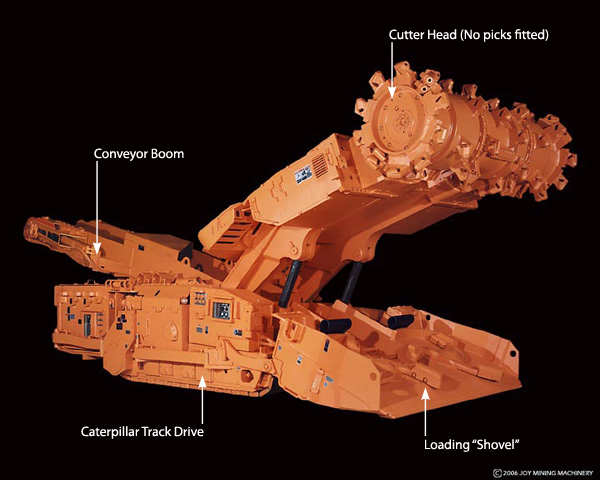
Though there are many variations in design, continuous miners mostly consist of five main elements:
  • A central body to carry all other components mounted on some type of drive mechanism to provide mobility (most commonly caterpillar tracks).
  • A "cutting head" usually rotating drum(s) and/or chains with cutting picks attached
  • A loading mechanism to pick up cut coal and deliver it into the central part of the machine
  • A conveying system, usually a chain conveyor running in a steel trough from front to rear of the miner
  • A rear jib section capable of a degree of vertical and horizontal movement to enable the coal to be delivered into a transport or loaded at a desired point.
x
Some continuous miners (at one time almost all) could not cut the full roadway width in one pass but had to be moved backwards and forwards and from side to side in order to cut the full profile. This often results in a very rough rib line (bad for stability and ventilation flow) and delays the ability to install support into/under freshly exposed roof for a period. The advantages of the ability to cut the full profile in one pass was recognized early, but was not easy to achieve. Cutting forward in a straight line could be readily accommodated, but it is necessary to be able to turn corners, mostly at right angles, and to be able to retreat the cutting machine from one roadway to relocate at frequent intervals. These factors have proved major stumbling blocks to many developments. In machines which covered the full face, steering in the vertical plane could also be a major difficulty.
The term "continuous" as applied to development machines has been one of the biggest misnomers used for mining equipment because, on development, they are usually anything but continuously cutting. The main delays mostly occur while roof support is installed and often waiting for shuttle cars to return from their discharge point for reloading. When actually cutting, cutting rates are usually more than adequate, but when averaged over a shift cutting rates are often poor and this is one of the reasons many mines have difficulty developing at rates adequate to prevent long delays on longwall production. As a result, development is an area receiving major attention in recent times. Many of the difficulties have been overcome and most modern continuous miners are "full face" machines. They also have roof bolting equipment mounted on the miner in locations allowing roof bolts to be installed reasonably close to the face.
The "ideal" continuous miner would:
  • Be able to cut the full face in one pass
  • Be easily moveable between locations without dismantling parts
  • Be able to excavate right angle turns with a minimum radius
  • Have roof and rib bolters fixed to the machine in a location where each row of the designed support pattern can be installed without moving the miner and be installed close to the cut face if necessary
  • Have adequate space alongside to allow good ventilation of the face area for efficient removal of gas and dust.
  • Allow strata supports to be safely installed while coal cutting continues
Many of these ideals have been achieved to varying degrees of satisfaction (the last being an area of minimal success), but matching development rates with longwall retreat rates is still a major problem for many mines. Increasing numbers of development units to attain longwall continuity is expensive and provides extra strain on all other service functions (personnel, ventilation, materials handling, power and water supplies, gas drainage, etc, etc) and is not usually a satisfactory solution.

Under Ground Coal Mining Development

Overview

The term "development" is normally used to refer to the drivage of all first workings roadways, whether main roadways or setting –out pillar areas ready for secondary extraction. Development in most mines is carried out by a number of separate development "units" each consisting of a full set of equipment (coal cutting machine, face transport equipment for coal and materials, roof support equipment and ventilation equipment) usually manned by more or less fixed crews on each shift. It is common for several such units to be operating more or less independently at several locations to support one or more longwall panels. In some mines however which do not operate longwall equipment, a development unit may become the secondary extraction unit having completed the first workings for a panel.
The following will only deal very briefly with development, this being the subject of a major section of this blog.

Issues to be Considered

In no particular order, issues which should be considered are:
  • Accesses are very expensive so their number and size (cross section and length) need to be minimized from a capital cost point of view
  • Excavated material has to be disposed of on surface which also suggests minimizing the number and size of accesses
  • Accesses carry the total mine airflow and the lower the resistance to flow the better, hence the size and number of accesses need to be maximized from a ventilation point of view (but length still to be minimized) – note that the power cost for ventilation is incurred 24 hours a day every day of the mine's life with rare fan stoppages for particular purposes
  • If the resistance to ventilation flow in the accesses is very high, extra roadways may be required throughout the mine to keep the overall resistance down to practical levels. If development mining is not profitable it may be more economic to excavate larger or increase the number of accesses instead
  • Desirability of keeping personnel and supplies transport in a separate access to coal haulage, and the desirability of keeping both in intake airways
  • Full extraction of coal cannot be carried out within an area around any access to ensure it remains stable – first workings only within the shaft or drift pillar. This area of sterilized coal needs to be minimized or located to coincide with an area where coal is already sterilized for other reasons

Areas of coal sterilised by shaft or drift pillars


Vertical Shaft


Drift
  • Strata/stress conditions – any access has to remain stable with minimum maintenance costs, for the life of the mine (in most cases), so locating accesses within potential adverse strata or stress conditions should be avoided
  • Size of equipment to be installed in the access or to be transported through it - the opening size not only needs to be large enough to fit the equipment in, but the effect of the equipment on the cross sectional area needs to be considered from a ventilation perspective.
  • Position within the lease – to one end (or side) or located centrally within the lease. There are both benefits and disadvantages in all options.
  • Means of personnel transport – travelling time, need to change from one type of transport to another.
  • Physical limitations on surface sites – avoid flood prone areas, site to be easily accessible for employees, materials supply to site and coal transport away from site.
  • Social limitations on surface sites – effect on local populations from noise, dust, visual pollution, traffic
  • Heritage/cultural limitations on surface sites
  • Zoning limitations on surface sites – non-industrial zonings, water catchment areas, etc
  • Availability of services – water and electric power supplies, disposal of waste water
  • Areas for disposal of waste rock
  • Timing – a minimum two accesses are required to be interconnected before any major development can take place, so they need to be reasonably close.
  • Provision for handling water and/or spillage made within the access
Note that not all the accesses have to be located at the same place if there are benefits in separating them.

ACCESS TO SEAM FROM SURFACE FOR UNDERGROUND COAL MINING


Overview

The means of gaining access to the coal seam from the surface is a matter to be decided early in the planning process and which can greatly affect the future operations for the whole life of the mine.
Decisions need to be made regarding the:
  • Type and function (e.g. coal haulage, personnel and/or materials transport, ventilation only)
  • Number
  • Size
  • Location
  • Construction method
of access openings, and possibly timing (not all may be required at the start of operations).
Note that, in Australia at least, legislation requires 2 independent means of access able to be traversed by personnel, so that there is always an alternative means of egress (commonly referred to as a second egress or emergency escapeway) from the mine available in the event the primary means becomes unavailable for any reason In addition to this requirement, the accesses must be adequate to allow for:
  • Sufficient ventilation quantities at acceptable ventilation pressures and costs
  • Efficient and safe transport of personnel and materials into and out of the mine
  • Installation of adequate services (e.g. electric power, water and usually compressed air reticulation systems and pumping or "waste water" reticulation system).
  • Coal transport at the required rate
  • Handling water make and spillage which occurs within the access
These requirements may be conflicting and some compromise is usually required, particularly when cost is taken into account. Lack of available capital may be a limiting factor and there may be time constraints (minimizing time to start of production so cash flow becomes available as soon as possible) which prevent the optimum design being installed.
It must also be decided if the accesses should allow for future expansion at this stage. The capital costs are very high and there are likely to be pressures to reduce costs pending commencement of production and subsequent positive cash flows. However carrying out modifications and/or extensions to mine accesses at a later stage within an operating mine can be particularly disruptive and expensive at a time where high fixed costs are present.

Common Planning Problems (Underground Mining)

Common Planning Problems

  1. A problem right at the start is getting agreement on definitions and terminology. As an example literature frequently refers to production rates per shift. What is often not stated is the shift length; if the rate is an average for all shifts, including non production shifts, or for only shifts where coal is cut; if it includes non production shifts is it for all or only planned non production. The rates actually used are not important as long as everybody is clear as to what is meant and is consistent, and as long as comparative information is adjusted to the same basis.

  2. It is obvious that any plan will only be accurate if the information included and the assumptions made are correct. With a new mine there is no experience in that location (though nearby mines may be able to provide this), no historical performance information and no historical costs available. As a result it will be no surprise if some variation between plan and actual results becomes apparent. When the vagaries of economic conditions are added to this, the likelihood of performance being exactly as planned is low. It is seldom likely after a few years' production that a mine layout closely resembles the original plan except where conditions are fairly simple or were well known in advance. It will be necessary to continue refining and adjusting the plan throughout the life of the mine.

  3. While it would appear self evident that such a complex organization with so many variables as a modern coal mine would require a high standard of planning, it is the writer's opinion that this is an area of the operations that is frequently poorly handled.
    Typically when a mine is first envisaged a project team is set-up involving a good range of expertise, the team usually increasing in size as the project advances and, because a very large investment is being made for a long term return on that investment, planning is very detailed and of a good standard. However the mine has no history to provide typical production rates, etc, and only has information from exploration which may have missed important factors.
    Once the mine reaches the production stage and the project is "completed", it is typically handed over to an operating team, the project team being dispersed, moved to another project or absorbed into the operating team, and it is from this point that planning tends to take a back seat. To start with a plan is already in place suited to what is known at that time and there is no reason to change it so planning has a low priority. Planning departments are often set-up within the management structure, staffed by personnel with other duties and frequently staffed by personnel with limited experience. There is often a high turnover of staff in planning departments as personnel progress to other more senior functions. As the lease becomes better known and various constraints (internal or external) become apparent the need to change the plan arises and the importance of planning increases, but this is not always recognized by an upgrade of planning departments.

  4. As well as the issues noted above, there are other factors which also act against planning being fully satisfactory
    • It is important that operational personnel are involved in the planning process, but in the eyes of operational personnel, planning for tomorrow will always be a lower priority than production today (after all, without the latter there will be no tomorrow).
    • Typically a plan drawn-up by one or two individuals will be overviewed and agreed to by the operational personnel, but the latter have little time available to give the plan the attention it requires.
    • There is a tendency for realistic plans which are not acceptable economically to be made acceptable by applying increased performance to the same resources - the "wishful thinking plan".
    • In the past the detailed planning/scheduling process was a tedious manual process and assessing alternatives was time consuming. Now there are excellent computer modeling processes available which make the process easier but which require a degree of expertise to operate properly. Consequently the computer model is frequently drawn-up by an expert in the modeling process overseen by an expert on the mine rather than the whole process being carried out by one person who knows both. This has potential for error and it suggests a large degree of refinement is required for planning programs to ensure end users are able to develop and use the planning models. It also reflects the junior status often attributed to planning (compared to production), the lack of computer literacy among more mature mining personnel and the lack of mining experience of a new generation of fully computer literate engineers.

MINE PLANNING

Planning Process

Once all the exploration information is available, planning can begin in earnest, though often it begins while the exploration process is still in progress.
The start of the planning process is the elimination of any parts of the lease which cannot be worked at all or cannot be readily mined for whatever reason. This, together with some knowledge of coal quality will allow an estimate of the value of the resource, depending on the assumptions made regarding operating costs, the percentage of coal recoverable and future sale prices.
Assuming the project continues past this point, the next step would be to decide seam access locations. This will require an assessment of possible surface sites taking into account all factors as described in the following section "Access to Seam from Surface", and the result will probably entail additional constraints on planned workings.
A decision has to be made on the type of operation – a longwall or continuous miner only operation and production levels desired, which will suggest the type of mine layout and quantity and size of equipment.
At this stage a mine layout has to be designed to fit in with the known constraints, either for the life of the mine or for an acceptable period (5, 10, 20 years, whatever is considered adequate by the mine owners). In order to do this, some strata stability assessments need to be made to ensure whatever pillar size(s) has been chosen is stable and what extent of roof support will be required (primary and secondary). A forecast of likely development and extraction rates will also be required.
Any layout should at least consider the best mining direction with regard to stresses (generally roadways parallel to the major principal stress are most stable), assuming something is known of the stress field. Consideration also needs to be given to seam gradients and any effects these may have on operations; what will happen to mine gases in goaf areas, where will waste water run or accumulate?
The time it will take to travel from surface to the face areas of the mine at different times in the mine life can become an important factor particularly with regard to personnel transport. While people are travelling they are being paid but are not doing productive work – either production stops during the shift change, or shifts overlap so the labour costs effectively double during the shift change (or even treble in the event of overtime being paid during travel time). This can affect the type of seam access chosen and its location.
Having completed a design for the mine (or maybe several alternatives), it will be necessary to see if it works satisfactorily. Initially this would be a physical check to see if, for example, the development units can complete panels in time for longwall continuity, if annual production rates are satisfactory, etc. This can be done manually, measuring on a mine plan where mining units will be periodically, but this is a very time consuming process.
There are now various types of computer program which can be used for planning purposes. These range from standard project management programs where information is in word or numerical form through to programs designed specifically for mining and which can also present information in a pictorial (plan) form.
The ability to ventilate the mine also needs to be checked and again there are computer programs available for this purpose, Ventsim being the most widely used in Australian underground coal mines.
Setting-up computer models and manipulating them is a somewhat specialized skill and, unless training of mine personnel can be justified for this purpose, specialist consultants are generally used.
If starting with a blank sheet, the number of possible variations to a mine design is large, and even with the use of computer models it is not practical to examine all of them. Some parameters will always have to be specified in advance to limit the modeling to be done (eg longwall face length is often specified in advance).
Initially, the model detail need not be great in order to quickly eliminate less successful options, but detail needs to be steadily increased as the best options become more apparent.
Having obtained a small number of likely options, financial details need to be included to evaluate the overall economics of each option. Most computer based mine planning programs are able to undertake basic financial and economic evaluations. Either forecasts have to be made with regard to relative costs and sale prices of the product (including movements in international currency values) or the evaluations are worked out in today's dollar values based on the assumption that relative values remain unchanged. It is possible that financial results may indicate the need for a complete revision of the mine plan at this stage.
Following the above process, possibly for several alternatives, a final optimized plan will emerge. This should be examined for sensitivity to a range of variables so that the key factors likely to affect performance are understood. This is a simple process once the computer model is constructed.
By this stage the degree of detail included in the model should be great. Even apparently small factors can have a major effect. As an example, say a niche to locate equipment has to be mined in each pillar of a longwall panel and each one takes only an hour to excavate and support. It would not be uncommon to have 40-50 pillars in a panel, so the niches amount to around 2 days work assuming 24 hour operations. To have a longwall idle for 2 days can easily amount to $2million or more of lost income, a not inconsiderable amount (it may not be totally lost but will not be recoverable until the end of the mine life which could be too far away to be considered).
It is suggested above that the planning process is a step by step process going from a starting point and progressing steadily to a finished plan. In truth it is more of an iterative process with several possible start points. As plans are developed, better ways of carrying out earlier parts may be identified requiring a reassessment of the plan from that part onwards.
Though the process will arrived at a "final" plan on which the project proceeds, this should be reviewed continually, including updating the latest position of mining units, the latest exploration information and possibly including adjusted production or development rates and costs/prices based on actual performance or revised forecasts. This ongoing planning process can be equally as important to a mine's success as the initial plan prior to the start.

EXPLORATION (Oveview)


Before any preparation for mining operations commence, it is necessary to know at least something of the resource to be exploited to be sure it will be an economic exercise. The gaining of information for this purpose is a process known as exploration. The process should include more than just geological factors and should include environmental and social factors as well.
How much exploration is required is a very difficult judgment to make. While there are certain legal requirements for Companies listed on the stock exchange with regard to the spacing of boreholes over a lease area in order to classify a resource (the JORC Code, the Australian Code for Reporting of Identified Mineral Resources and Ore Reserves), much more is required for mine planning and operational purposes. Ultimately it is an exercise in risk management – the greater the level of information obtained with regard to the planning and operation of a potential mine site, the lower the risk in relation to unforeseen factors which can greatly affect the mine's future profitability
Almost any form of exploration is expensive so as a general rule one should obtain as much information as possible from each individual operation. For example it may be desirable to drill a borehole at a location primarily to obtain coal quality information. However, having drilled to the seam it would be sensible to collect as much information as possible from that hole (e.g. gas content, immediate roof and floor materials, seam depth, etc) as the extra information would only necessitate incremental extra costs.
With most lease areas, something is likely to be known of the resource at the commencement of the project evaluation due to the conduct of earlier exploratory drilling by relevant government authorities. However, this information is frequently limited in nature and may only indicate that there is a resource of some sort present.
There is a wide range of exploration techniques available from very basic visual examination through to sophisticated geological processes, and a mixture of these is normally used.
A program could well follow a process as listed below, though the sequence may be a little different depending on time and resources available. There should be frequent reviews throughout, certainly after each phase, to see if information gained requires changes to the future work plan or if in fact it indicates that work should be postponed or even abandoned altogether.
  1. The starting point of any exploration program would be a search of any publically available information related to the permit or lease area. This would particularly relate to drilling records or geological surveys (often provided as part of the Invitation to Tender documents) but should also include such items as climate records, land use and zoning, cultural or heritage reports. Historical records for the area may even be of use. Bore cores from old drilling programs may also be available for inspection.
  2. Probably in conjunction with phase 1, enquiries should be made regarding availability of private information which may be obtained (possibly purchased). Such information may be obtainable from sources such as local water bore drillers, farmers on outcrop areas, planning and statutory authorities and similar sources and may also be available from other mining or oil interests (who may have had aerial surveys of some type carried out). In particular, information should be sought from any neighbouring or nearby mines as this latter source of information, if available, is of great value as seam conditions generally only change gradually over distance.

  3. Also possibly in conjunction with phases 1 and 2, a visual inspection of the surface topography should be carried out. This can be done from the air to some extent but at least a large portion should be on the ground and probably on foot. Geological expertise is required on such exploration. Heritage/cultural expertise and botanical/zoological assessment will also be required at some stage, but unless access is particularly difficult these can be included at a later stage in order to defer costs which may not be required if the project does not proceed. These latter assessments will probably be required at an early stage if drilling is to be carried out.

  4. A review of the above phases will often result in parts of the permit or lease being removed from any future exploration because that part of the resource will not be economic or be subject to surface constraints (water courses, dams, heritage buildings, archaeological sites, bridges, national parks, etc). It may also identify where drilling or other types of surface based exploration may be restricted for similar reasons.

  5. At this point a decision has to be taken as to whether or not to carry out additional surface (possibly aerial) surveys such as magnetometer surveys (comprising detection of changes in the Earth's magnetic field at a localized level which indicate changes in mineralogy or the presence of geological features) seismic surveys (comprising the detection of surface initiated sound vibrations as reflected by underground strata and structures). This may be beneficial to assist in designing the best drilling programme or it may be preferable to carry out drilling first to decide if such surveys are worthwhile.

  6. At some stage, a drilling exploration program will almost certainly be required. This will most likely involve cross measure drilling from surface to seam. At least some, if not all of these holes will involve coring of a substantial length of the strata and certainly of the seam itself. A proportion of the holes should also involve drilling below the seam(s) likely to be worked at least to the lowest seam in the sequence or at least to a depth which may be affected by any goaf above. Apart from standard geological information regarding strata sequences and thicknesses and possible indications of structures, any borehole can be tested for:
    • Coal quality and washability
    • Coal or rock strength and other properties
    • Stress magnitude and direction
    • Ground water information
    • Seam and surrounding strata gas content and composition
    It is not worth paying for information which will be filed and never used, but having to drill another hole later to collect information not obtained initially is very expensive. It is therefore usually worthwhile to maximize the information collected. Note that more than one core can be obtained from a single borehole, if required.
Usually, a drilling program will complete the exploration of a lease area, but it should be noted that not all the drilling may be done at the one time. It is only necessary initially to fully explore enough of the lease to ensure it is economic. Further exploration can be, and normally is, carried out after the mine has started, provided it is done in advance of the areas to be worked.
Some exploration may be carried out from underground once work sites are available, using in seam boreholes rather than drilling from surface. This has the advantages of reducing potential effects on surface areas and covering extensive distances in- seam and utilizing holes which have to be drilled for other purposes. However, it is more difficult to drill "cross measure holes" (holes which cut across layers of strata rather than follow them) ahead of the workings from underground if cross measure drilling is required.
Because of the expense involved with boreholes the possible use of exploration holes for other purposes or vice versa should also be considered. Coal bed methane production is becoming more common, whether primarily for gas production or to remove gas prior to mining. If these holes can be used for exploration without compromising their use for gas drainage then savings can be obtained.
There is a tendency in recent times to run mine services (air, water, power cables, etc) in boreholes rather than in drifts or shafts - exploration holes could be used for this purpose if the required location can be decided before the exploration is carried out. It is unlikely that exploration boreholes will be able to be used for such purposes unless a decision is taken prior to completing the holes and the holes are lined rather than being filled with cement or similar to prevent them becoming a potential water inrush hazard if intersected by mine workings.

The Mining Process

Once a mining lease has been awarded to an operator, exploration (i.e. evaluation of the resource) takes place, followed by a planning and development process before excavation or mining begins.
The initial task is to gain access to the seam from the surface by some means (shafts, drifts, etc – see Access to Seam from surface section for these terms).
Once access has been gained into the coal seam, workings are developed by mining a series of roadways (or "headings"). These roadways are tunnels largely, if not totally, within the seam, usually rectangular in shape though on occasions they may have an arched or even circular profile. The roadways are connected at intervals by other roadways known as "cut-throughs", thus forming areas of coal "pillars", most commonly but not always rectangular in shape. These pillars should be of a size which is stable (i.e. they will not crush out) for the existing strata/stress conditions and for any future altered conditions caused by further excavation. The minimum pillar size may be specified by legislation (e.g. the smallest dimension to be not less than 10% of the seam depth below surface) but this can usually be varied with approval of the statutory authority if assessment by appropriate experts indicates there is no unacceptable risk involved.
The roadways are commonly around 5m wide, and a maximum width may be specified by legislation (this again may be varied with approval after assessment of the risk). They are typically driven at 2.5 to 3.5m in height (which accounts for over 95% of all Australian coal mine roadways). In thinner seams they may be partly driven in roof or floor strata whilst in thicker seams coal may be left in the immediate roof or floor to provide a comfortable working height and/or to control roof or floor conditions. Whatever height is chosen is referred to as the "working height".
Such roadways need to be stable for extended periods (some for the whole life of the mine) and in most mines this means supports need to be installed to reinforce the roof and in many mines, the sides (referred to as "ribs") and sometimes even the floor strata. This support work is an expensive process, primarily due to the extent of manual handling and operation involved.
For this reason, such sets of roadways are usually driven at different locations and in different directions to delineate larger blocks of coal to be extracted by other means.
The above process is referred to as "first workings" or now more commonly as "development". Provided the pillars remain stable, this type of mining will not give rise to subsidence at the surface In some mines or parts of mines first workings is the only type of mining permitted, where surface or sub-surface structures need to be protected or projected levels of subsidence are unacceptable. For most mines, however, it would be uneconomic to operate with first workings only.
For this reason, other methods of mining have been developed to remove large blocks of coal between areas of first workings, methods which require minimal "permanent" support or which use temporary, reusable supports. Usually the coal from these large blocks is extracted while retreating from a boundary back to the main mine access and the roof strata is allowed to collapse into the cavity formed, such an area of collapsed roof being known as a "goaf" (at other times and places also referred to as a "waste" or "gob"). The plural of "goaf" is usually written as "goaves".
This stage of mining is known as "second workings" or "pillar extraction". Longwall mining is one method of pillar extraction, now the most common method in use in Australia, and probably worldwide. Before longwall mining methods had been developed to operate satisfactorily in most conditions, a lot of pillar extraction was carried out using continuous miners, and such methods are still in use in places for a variety of reasons.

Surface mining

Surface comprises 90% of the world's mineral tonnage output. Also called open pit mining, surface mining is removing minerals in formations that are at or near the surface. Ore retrieval is done by material removal from the land in its natural state. Surface mining often alters the land characteristics, shape, topography, and geological make-up.
Surface mining involves quarrying which is excavating minerals by means of machinery such as cutting, cleaving, and breaking. Explosives are usually used to facilitate breakage. Hard minerals such as limestone, sand, gravel, and slate are generally quarried into a series of benches.
Strip mining is done on softer minerals such as clays and phosphate are removed through use of mechanical shovels, track dozers, and front end loaders. Softer Coal seams can also be extracted this way.
With placer mining, minerals can also be removed from the bottoms of lakes, rivers, streams, and even the ocean by dredge mining. In addition, in-situ mining can be done from the surface using dissolving agents on the ore body and retrieving the ore via pumping. The pumped material is then set to leach for further processing. Hydraulic mining is utilized in forms of water jets to wash away either overburden or the ore itself.

Mining operation

Mining engineers working in an established mine may work as an engineer for operations improvement, further mineral exploration, and operation capitalization by determining where in the mine to add equipment and personnel. The engineer may also work in supervision and management, or as an equipment and mineral salesperson. In addition to engineering and operations, the mining engineer may work as an environmental, health and safety manager or design engineer.
The act of mining required different methods of extraction depending on the mineralogy, geology, and location of the resources. Characteristics such as mineral hardness, the mineral stratification, and access to that mineral will determine the method of extraction.
Generally, mining is either done from the surface or underground. Mining can also occur with both surface and underground operations taking place on the same reserve. Mining activity varies as to what method is employed to remove the mineral.


Feasibility study

Once the mineral identification and reserve amount is reasonably determined, the next step is to determine the feasibility of recovering the mineral deposit. A preliminary study shortly after the discovery of the deposit examines the market conditions such as the supply and demand of the mineral, the amount of ore needed to be moved to recover a certain quantity of that mineral as well as analysis of the cost associated with the operation. This pre-feasibility study determines whether the mining project is likely to be profitable; if it is then a more in-depth analysis of the deposit is undertaken. After the full extent of the ore body is known and has been examined by engineers, the feasibility study examines the cost of initial capital investment, methods of extraction, the cost of operation, an estimated length of time to payback, the gross revenue and net profit margin, any possible resale price of the land, the total life of the reserve, the total value of the reserve, investment in future projects, and the property owner or owners' contract. In addition, environmental impact, reclamation, possible legal ramifications and all government permitting are considered. These steps of analysis determine whether the mine company should proceed with the extraction of the minerals or whether the project should be abandoned. The mining company may decide to sell the rights to the reserve to a third party rather than develop it themselves, or the decision to proceed with extraction may be postponed indefinitely until market conditions become favorable.

Mineral determination

After a prospective mineral is located, the mining engineer then determines the ore properties. This may involve chemical analysis of the ore to determine the composition of the sample. Once the mineral properties are identified, the next step is determining the quantity of the ore. This involves determining the extent of the deposit as well as the purity of the ore. The engineer drills additional core samples to find the limits of the deposit or seam and calculates the quantity of valuable material present in the deposit.

History of mining engineering

From prehistoric times to the present, mining has played a significant role in the existence of the human race. Since the beginning of civilization people have used stone and ceramics and, later, metals found on or close to the Earth's surface. These were used to manufacture early tools and weapons. For example, high quality flint found in northern France and southern England were used to set fire and break rock. Flint mines have been found in chalk areas where seams of the stone were followed underground by shafts and galleries. The oldest known mine on archaeological record is the "Lion Cave" in Swaziland. At this site, which radiocarbon dating indicates to be about 43,000 years old, paleolithic humans mined mineral hematite, which contained iron and was ground to produce the red pigment ochre.
The ancient Romans were innovators of mining engineering. They developed large scale mining methods, such as the use of large volumes of water brought to the minehead by numerous aqueducts for hydraulic mining. The exposed rock was then attacked by fire-setting where fires were used to heat the rock, which would be quenched with a stream of water. The thermal shock cracked the rock, enabling it to be removed. In some mines the Romans utilized water-powered machinery such as reverse overshot water-wheels. These were used extensively in the copper mines at Rio Tinto in Spain, where one sequence comprised 16 such wheels arranged in pairs, lifting water about 80 feet (24 m).
Black powder was first used in mining in Banská Štiavnica, Kingdom of Hungary (present-day Slovakia) in 1627. This allowed blasting of rock and earth to loosen and reveal ore veins, which was much faster than fire-setting. The Industrial Revolution saw further advances in mining technologies, including improved explosives and steam-powered pumps, lifts, and drills as long as they remained safe.

Mining Engineering

Mining engineering is an engineering discipline that applies science and technology to the extraction of minerals from the earth. Mining engineering is associated with many other disciplines, such as geology, mineral processing and metallurgy, geotechnical engineering and surveying. A mining engineer may manage any phase of mining operations – from exploration and discovery of the mineral resource, through feasibility study, mine design, development of plans, production and operations to mine closure.
With the process of Mineral extraction, some amount of waste and uneconomic material are generated which are the primary source of pollution in the vicinity of mines. Mining activities by their nature cause a disturbance of the natural environment in and around which the minerals are located. Mining engineers must therefore be concerned not only with the production and processing of mineral commodities, but also with the mitigation of damage to the environment both during and after mining as a result of the change in the mining area.